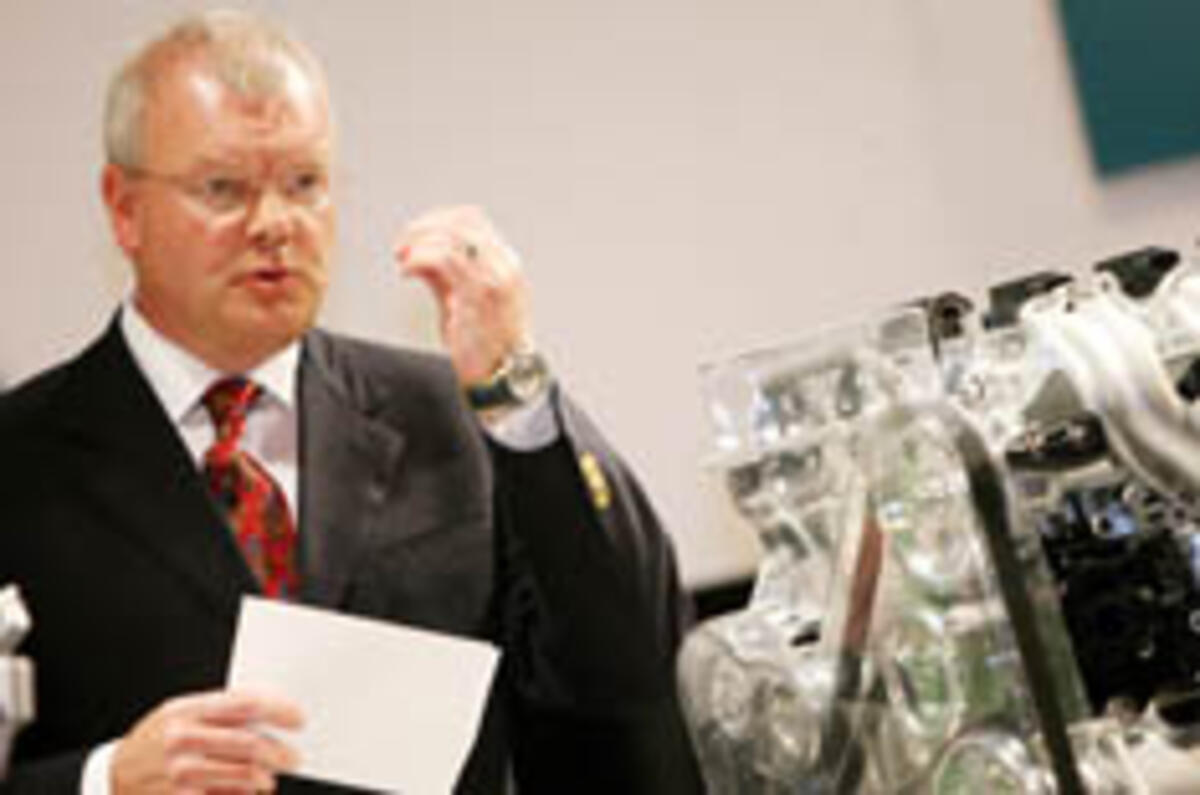

The average family car could emit just 40g/km of CO2 by the middle of the century, Richard Parry Jones told an Autocar-sponsored lecture in central London on Wednesday.
Parry-Jones - one of the world’s leading automotive engineers who was Ford’s global Chief Technical Officer - said that if proper long-term planning happens now, massive reductions in CO2 from cars is entirely possible. He believes that the equivalent of 180mpg with today's technology will be a reality by 2050.
But rather than forcing emissions-slashing legislation on the motor industry, Parry-Jones believes that governments should allow carmakers to set a ‘glide path’ toward reducing CO2 and meeting green targets over the next few decades.
In the short term, adjustment to aerodynamics, weight reduction, reduced rolling resistance and recalibration of engine management systems will allow a typical Ford Focus to dip below the 100g/km emissions barrier by 2015. Parry-Jones added that battery technology, typically used in hybrid cars, is too expensive and ‘not evolving fast enough’. Crucially, the former Ford executive said he felt that personal mobility should not be curtailed by central government as a reaction to the Climate Change consensus.
He also called on the government to resist the temptation to pick environmental ‘winners’ at this stage of the technology cycle, instead leaving the industry to find the best ways to reduce CO2. During the Autocar speech to top motor industry figures, Parry-Jones also criticised what he called the ‘demonisation’ of motoring, along with ‘punitive fiscal policies’ and the halt in the expansion of the UK’s road network.
He also thinks that, in the future, families will have numerous cars, with the design of each optimised for ‘city, urban and inter-city’ use.