
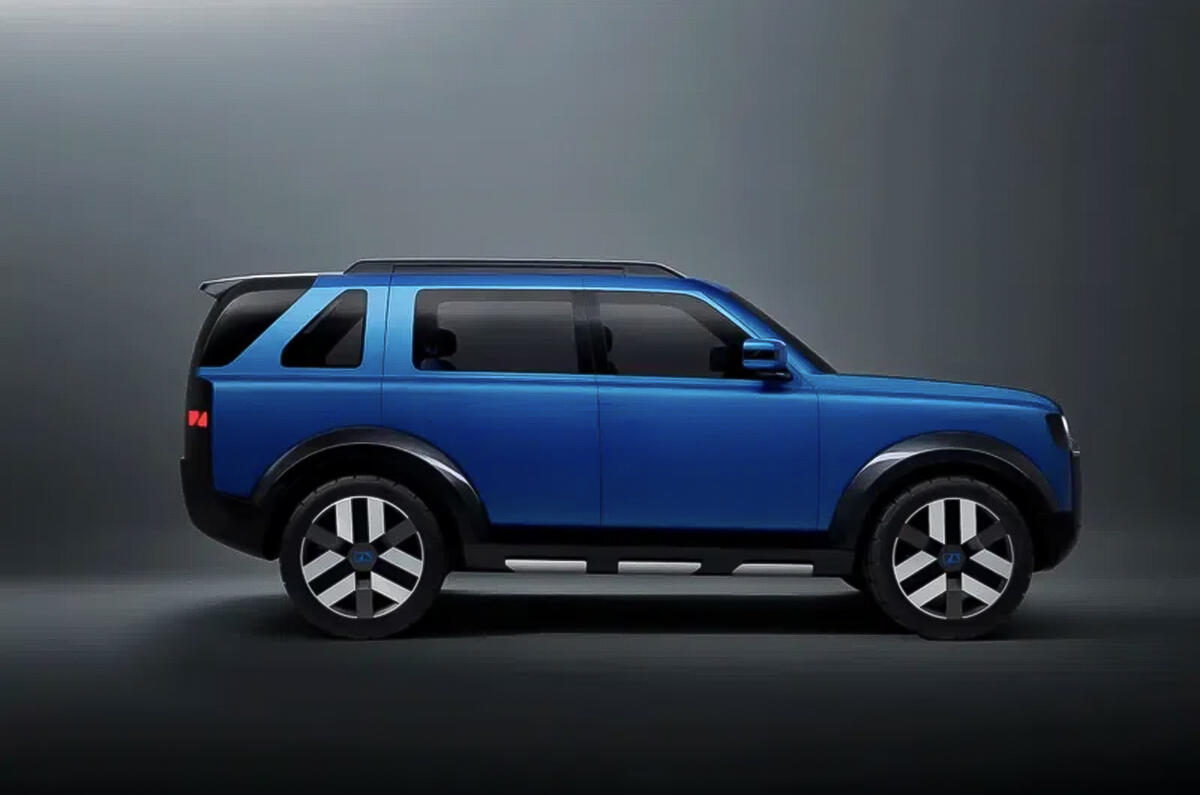

JLR and its Chinese partner Chery have revealed the first model in the Freelander range of cars, but there remains a question: where would this fit in the current Land Rover line-up?
The first of the new Freelanders will be a chunky, three-row plug-in hybrid with familiar off-road design cues and advanced technology, for example a take on BMW’s full-width screen sitting under the windscreen.
The platform and tech comes from Chery, much of which will be familiar to buyers of the Omoda 9 or Chery Tiggo 9. It’s clearly the right car at the right time, but could it work in the UK?
Chery-JLR has established a retail network in China already but not said which half of the joint venture will take the lead on sales in export markets like Europe.
On one hand, this is clearly a car that JLR dealers will clamour to stock. The success of Omoda, Jaecoo and Chery models shows us that Chery’s ubiquitous T1X platform on which the Freelander also sits has passed the first hurdle of acceptability.
Freelander may be a standalone brand, but the new Concept 97 shows that JLR’s supervision has nailed the aesthetic enough to bring fresh weight to a name that most Brits will already know well.
A seven-seat PHEV with the latest tech in a fresh off-road styling package with the heft of JLR behind it ticks a lot of boxes.
So we can be fairly confident it would sell in the UK. But cannibalisation has always been a problem at JLR with its focus on SUVs.
Most at risk of being eaten is the upcoming Defender Sport. Designed on JLR’s EMA electric platform and expected next year, this is also a chunky off-roader with the latest tech. Except it will be built in Halewood and not Shanghai, with the attendant cost hike that brings – and it will lack the combustion engine option of the Freelander.
Any Freelander import would also knock any remaining stuffing out of the Discovery Sport and maybe even the Discovery too, given the likely price and tech advantage.
One possible solution could be if JLR commissioned its joint venture to produce an upmarket derivative, like a 'Defender Sport 130' PHEV, on the Chery platform for export. Then it could have a model that brings all the tech and cost-saving associated with China development but with a higher level of finish and brand elevation than Freelander to separate the two.
Or perhaps a more radical approach could be the play. Chery has shown it is more than willing to inundate markets with new brands as it experiments with what works and what doesn’t. JLR meanwhile is the brand curator par excellence. With Freelander, it might have the courage to be able to say that this is now the new Discovery, the entry brand with practical tech appeal that leverages the nimble Chinese automotive sphere of influence.



Join the debate
Add your comment
Maybe the Chinese car industry are doing in car design what the West has been reluctant to do for our market, in the UK we went crazy when Ford dropped the Focus and the the Fiesta,they didn't think maybe time for a change, move the design forward,beat there competitors, but no, we sat on our hands and here we have another of the UK's iconic brands cars reimagined by the Chinese.
I always thought it would be great if the Discovery was re-imagined as a 'new-age' rugged, and upmarket people carrier/MPV. That would possibly be a compelling offering when compared to the sea of SUVs currently being launched...
Curiously, until recently, journalists at this publication (see Rachel Burgess and Alastair Clements, October 26, 2005) wondered whether a Jaecoo 7 could compete with a considerably more expensive Range Rover Evoque. And now, here's a JLR-branded SUV based on the same platform as the Jaecoo. For now, it's reserved for exotic markets, but who knows? In the future, it could be a full-fledged (although China-built) JLR that costs far less and is more reliable.